
Mastering direction words in Chinese opens up a world of precise communication, from giving clear directions to describing spatial relationships with accuracy. These fundamental words—shang (up), xia (down), zuo (left), you (right)—form the backbone of everyday conversations and written descriptions. Unlike English, Chinese direction words often combine with other elements to create compound expressions that convey both location and movement. Understanding their grammatical behavior and proper usage patterns will significantly enhance your Mandarin proficiency and help you avoid common pitfalls that many learners encounter.
Fundamental Chinese Direction Words
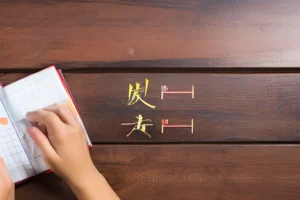
The core direction words in Mandarin consist of four primary terms that establish basic spatial orientation. Shang (上) indicates upward direction or position above, while xia (下) represents downward movement or position below. Zuo (左) specifies leftward orientation, and you (右) indicates rightward direction. These words frequently combine with nouns to form compound expressions that describe specific locations. For example, shangmian (上面) means “above” or “on top of,” while xiamian (下面) indicates “below” or “underneath.” The versatility of these words extends beyond literal directions, as they often appear in metaphorical expressions and idiomatic phrases that enrich the language.
Chinese direction words demonstrate consistent grammatical patterns that differ significantly from English usage. Unlike English prepositions that typically precede nouns, Chinese direction words often follow the nouns they modify. Consider the sentence “The book is on the table,” which translates to “Shu zai zhuozi shang” (书在桌子上). Here, shang follows zhuozi (table) rather than preceding it. This post-positional characteristic represents a fundamental structural difference that requires conscious practice to master. Many learners initially struggle with this word order, but understanding this pattern early will prevent persistent errors in sentence construction.

Compound Direction Expressions and Usage
Chinese frequently combines basic direction words to create more specific compound expressions that describe diagonal or intermediate directions. Common combinations include youshang (右上) for “upper right,” zuoxia (左下) for “lower left,” and other variations that provide precise spatial information. These compounds maintain consistent grammatical rules while expanding your descriptive capabilities. When using compound directions, the word order remains crucial—the primary direction typically precedes the secondary direction, creating logical and predictable patterns that native speakers instinctively follow.
Literal Versus Metaphorical Usage
Direction words in Chinese extend far beyond physical space into abstract and metaphorical domains. Shang frequently appears in contexts indicating improvement or advancement, as in shangsheng (上升) meaning “to rise” in economic or social contexts. Xia often conveys decline or reduction, evident in xiajiang (下降) for “to decrease.” These metaphorical extensions demonstrate how deeply direction concepts permeate Chinese thought and expression. Understanding both literal and figurative applications will significantly enhance your comprehension of authentic Chinese materials, from news reports to literary works.
The relationship between direction words and other grammatical elements requires careful attention. These words often interact with measure words when quantifying locations or directions. To understand this better, read our article on Chinese Measure Words Guide. This connection highlights how different grammatical systems in Mandarin interconnect to create coherent expressions. Similarly, direction words frequently appear alongside particles that modify their meaning or indicate aspect. For comprehensive particle coverage, consult our Chinese Particles Guide to understand these relationships more deeply.
Common Errors and Correction Strategies
Learners frequently make predictable errors when using Chinese direction words, particularly regarding word order and particle usage. The most common mistake involves placing direction words before nouns instead of after them, directly translating from English sentence structures. Another frequent error concerns the misuse of particles with direction words, especially confusing le (了) and zhe (着) in directional contexts. For detailed particle explanations, explore our resource on Chinese Particles: 了, 着, 过 to clarify these distinctions.

Practice Exercises and Application
Effective mastery of Chinese direction words requires consistent practice with varied exercises that reinforce proper usage patterns. Begin with simple location descriptions using basic direction words, then progress to more complex sentences incorporating compound directions and metaphorical usage. Practice describing room layouts, giving street directions, and explaining spatial relationships between objects. Regular writing exercises that incorporate both literal and figurative direction word usage will build muscle memory for correct grammatical structures and expand your expressive range in Mandarin.
Advanced applications of direction words include their use in formal writing, technical descriptions, and literary expressions. As your proficiency grows, you’ll encounter increasingly sophisticated implementations that demonstrate the full expressive potential of these fundamental words. Pay particular attention to how direction words combine with other grammatical elements to create nuanced meanings that reflect Chinese spatial conceptualization. This deeper understanding will enable you to move beyond basic communication toward truly authentic Mandarin expression that resonates with native speakers.
Integration with Broader Grammar Systems
Chinese direction words don’t exist in isolation—they form an integral part of the language’s comprehensive grammatical framework. Their usage intersects with numerous other grammatical categories, including aspect markers, measure words, and sentence particles. Understanding these connections will help you see Mandarin as an interconnected system rather than a collection of separate rules. This holistic perspective accelerates language acquisition and enables more natural production, as you’ll recognize patterns that recur across different grammatical domains.
The journey to mastering Chinese direction words represents a significant step toward fluency in Mandarin. These fundamental elements appear constantly in daily communication, written materials, and formal contexts. By internalizing their grammatical patterns, understanding their metaphorical extensions, and practicing their correct usage, you’ll build a solid foundation for more advanced language study. Remember that consistent practice with authentic materials and attention to native speaker usage patterns will reinforce your learning and help you avoid fossilized errors.
Ready to take your Chinese grammar to the next level? Begin incorporating these direction words into your daily practice sessions, paying close attention to word order and compound formations. Challenge yourself to describe your surroundings using precise directional language, and seek out authentic Chinese materials that demonstrate these concepts in context. With dedicated practice and attention to grammatical details, you’ll soon use Chinese direction words with the confidence and accuracy of an advanced learner moving steadily toward fluency.