Ever felt nervous about eating at a Chinese restaurant with Chinese friends or colleagues? Worried you’ll accidentally break a cultural rule you didn’t even know existed?
Chinese dining etiquette is rich, nuanced, and deeply tied to values like respect, hierarchy, and social harmony. But here’s the good news: once you understand the key principles, navigating Chinese meals becomes natural and enjoyable!
This comprehensive guide will walk you through everything from chopstick taboos to seating arrangements, tea rituals to toasting customs—so you can dine with confidence in any Chinese setting! 🥢
Why Chinese Dining Etiquette Matters
In Chinese culture, meals aren’t just about food—they’re about relationships. Business deals are often made over dinner, family bonds are strengthened through shared meals, and social status is reflected in seating and serving order.
Understanding dining etiquette shows:
- Respect for Chinese culture and traditions
- Social awareness and sophistication
- Willingness to integrate and connect
- Understanding of hierarchy and relationships
Making a dining faux pas won’t end relationships, but proper etiquette opens doors and builds trust.
The Philosophy Behind Chinese Dining
Communal vs Individual
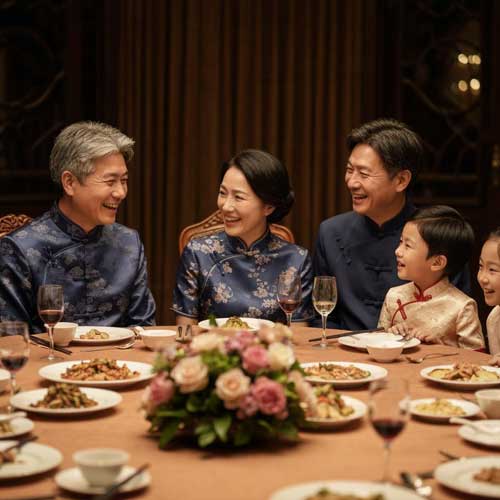
Unlike Western dining where everyone orders their own dish, Chinese meals are communal. Multiple dishes are placed in the center, and everyone shares from the same plates.
This reflects: The Chinese value of collectivism over individualism, and the importance of family/group harmony.
The Round Table Philosophy
Traditional Chinese dining uses round tables (especially for formal occasions) because:
- Everyone is equally included (no “head” of the table like rectangular Western tables)
- Easy rotation of dishes (often via lazy Susan)
- Symbolizes unity and completeness
- Facilitates conversation among all diners
However, even at a round table, hierarchy still exists through seating positions!
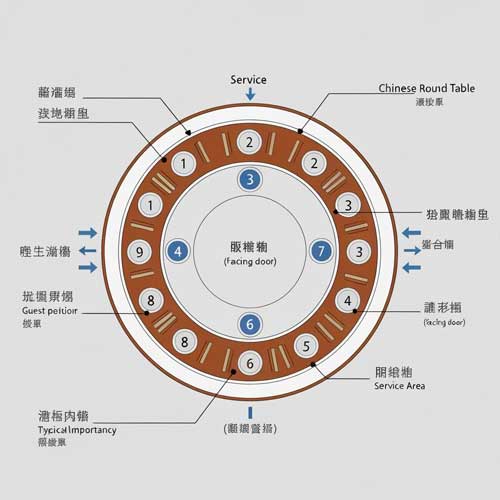
Chinese Seating Etiquette: Who Sits Where?
The Seat of Honor (主位, Zhǔwèi)
Location: The seat facing the door/entrance, or the seat with the best view
Who sits here: The most important guest, eldest person, or highest-ranking individual
Why: This position allows the honored guest to see who enters and has the most commanding view
The Host’s Position (主陪, Zhǔpéi)
Location: Directly opposite the seat of honor (back to the door)
Who sits here: The host who organized/pays for the meal
Role: The host serves guests, manages the meal flow, and ensures everyone is comfortable
General Seating Hierarchy:
At a round table:
- Seat of honor – Most important guest (facing door)
- Left of honor – Second most important
- Right of honor – Third most important
- Host position – Opposite the seat of honor
- Co-host – Opposite seat #2
- Remaining guests by importance/age
Practical Tips:
- Don’t sit down immediately – Wait for the host to indicate where you should sit
- If unclear, wait – Let older/more important people sit first
- Don’t take the seat of honor unless specifically directed
- When in doubt, ask! – “我坐哪里?” (Wǒ zuò nǎlǐ? – Where should I sit?)
Chopstick Etiquette: The Essential Rules
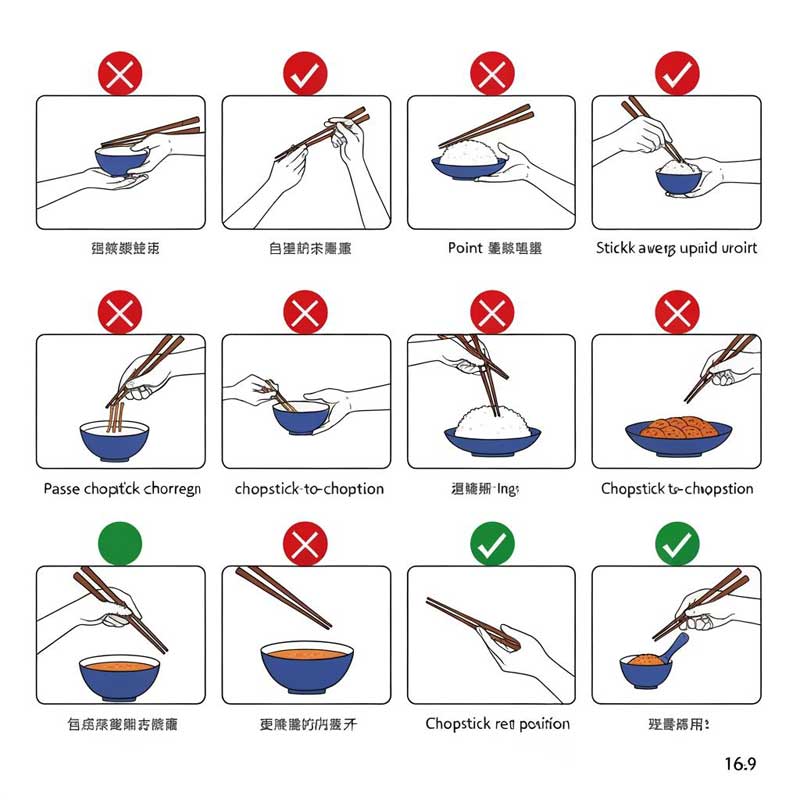
Chopsticks aren’t just eating utensils in Chinese culture—they carry deep symbolic meaning. Some chopstick behaviors are considered extremely rude or even taboo!
✅ DO: Proper Chopstick Etiquette
1. Hold Chopsticks Correctly
Proper technique shows cultural awareness (though imperfect holding is usually forgiven for foreigners).
2. Use the Serving Utensils
When available, use 公筷 (gōngkuài) – communal serving chopsticks – to take food from shared dishes. This has become especially important since COVID-19.
3. Rest Chopsticks Properly
Place them on the chopstick rest (筷架, kuàijià) or across your bowl/plate. Never stick them upright in rice!
4. Take Food Politely
- Take food from the side of the dish nearest you
- Take reasonable portions (you can always get more)
- Don’t dig through dishes looking for “the best piece”
❌ DON’T: Chopstick Taboos
1. NEVER Stick Chopsticks Upright in Rice (插筷子)
Why it’s taboo: This resembles incense sticks at funerals and is associated with death. This is one of the most serious chopstick taboos!
2. NEVER Pass Food Chopstick-to-Chopstick
Why it’s taboo: This resembles a funeral ritual where cremated bones are passed between family members using chopsticks.
Instead: Place food on the person’s plate, or let them take it themselves.
3. Don’t Point with Chopsticks (指筷子)
Pointing at people with chopsticks is rude—like pointing your finger at someone.
4. Don’t Spear or Stab Food
Use chopsticks to pick up food, not stab it like a fork (unless the food is too slippery and everyone’s doing it).
5. Don’t Wave Chopsticks Around
Keep them still when not eating. Waving them while talking is seen as aggressive or uncouth.
6. Don’t Suck on Chopsticks
This is considered childish and improper.
7. Don’t Cross Chopsticks
Crossing chopsticks on your bowl or plate symbolizes negation or “no” and is unlucky.
8. Don’t Tap Chopsticks on Bowl
This is what beggars do to attract attention. It’s considered very rude at a proper meal.
9. Don’t Use Chopsticks as Drumsticks
No playing or making noise with chopsticks!
What If You Drop Your Chopsticks?
Simply ask for a new pair: “不好意思,可以给我一双新筷子吗?” (Bù hǎoyìsi, kěyǐ gěi wǒ yī shuāng xīn kuàizi ma?) – “Excuse me, could I have a new pair of chopsticks?”
Serving and Being Served
The Art of Serving Others (让菜, Ràng Cài)
In Chinese dining culture, serving food to others is a sign of respect and care. This is especially important when dining with elders or honored guests.
How to serve others properly:
- Use serving chopsticks (公筷), never your personal chopsticks
- Place food on their plate, not directly into their mouth
- Serve the best pieces to honored guests or elders
- Rotate the lazy Susan so good dishes face important people
- Say something polite: “多吃点” (Duō chī diǎn) – “Please eat more”
When Others Serve You:
Always accept graciously! Even if you don’t particularly want it, refusing can be seen as rejecting their kindness.
Polite responses:
- “谢谢!” (Xièxie!) – Thank you!
- “够了够了” (Gòu le gòu le) – That’s enough! (if they keep serving)
- “您也吃” (Nín yě chī) – Please eat too (deflecting attention back)
The Lazy Susan Protocol
Direction: Always rotate clockwise (some say counter-clockwise in certain regions, but clockwise is most common)
Speed: Rotate slowly and carefully—don’t send dishes flying!
Priority: Wait for elders/important guests to take food first before rotating
Taking food: Stop the lazy Susan while you take food, then continue rotating
Chinese Tea Culture & Etiquette
Tea is integral to Chinese dining culture, especially at formal meals or dim sum!
The Finger Tap “Thank You” (叩指礼, Kòuzhǐ Lǐ)
When: Someone pours tea for you
What to do: Tap your index and middle fingers (bent) on the table 2-3 times near your tea cup
Meaning: “Thank you” without interrupting conversation
Origin legend: This gesture represents a person bowing—the two fingers are like a person’s head bowing in gratitude!
Pouring Tea Etiquette
Always pour for others before yourself!
Order of pouring:
- Eldest person or most honored guest first
- Other guests by age/importance
- Yourself last
How to pour:
- Hold teapot with one hand, other hand supporting the lid
- Fill cups about 70-80% full (not to the brim)
- Chinese saying: “酒满敬人,茶满欺人” – “Full wine shows respect, full tea shows disrespect”
Why not fill tea completely? Hot tea can burn someone’s lips or fingers, and it shows you’re rushing them to finish!
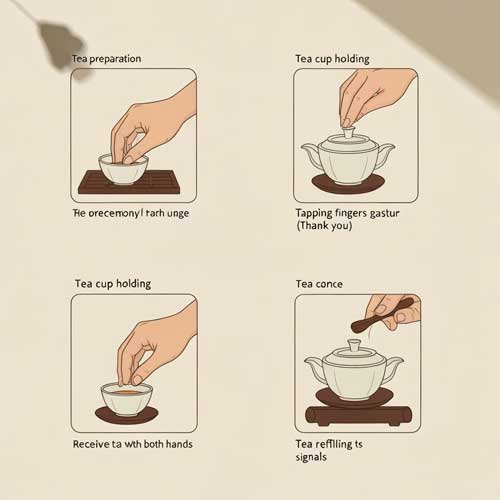
Signaling You Want More Tea
Leave your teapot lid slightly open or resting askew on the pot. This signals to servers you need a refill!
Receiving Tea with Both Hands
When someone pours tea for you (especially if they’re senior or hosting), place your right hand under the cup and left hand near your heart as a sign of respect.
Toasting Etiquette (敬酒, Jìng Jiǔ)
Alcohol (especially baijiu 白酒, beer, or wine) plays a significant role in Chinese business and social dining!
Basic Toasting Rules:
1. The Host Toasts First
Wait for the host to make the first toast before drinking. Don’t start drinking on your own!
2. Hold Your Glass Lower
When toasting someone senior or more important, hold your glass slightly lower than theirs as a sign of respect.
3. Use Both Hands
Hold your glass with both hands when toasting seniors or important guests—right hand holding the glass, left hand supporting the bottom.
4. Make Eye Contact
Look at the person while toasting and drinking.
5. Say Something!
Common toasting phrases:
- 干杯!(Gānbēi!) – “Bottoms up!” (literally “dry cup” – you should finish your drink)
- 随意 (Suíyì) – “As you like” (you can sip instead of finishing)
- 祝您身体健康!(Zhù nín shēntǐ jiànkāng!) – “Wishing you good health!”
- 合作愉快!(Hézuò yúkuài!) – “To successful cooperation!” (business)
How to Politely Decline Alcohol:
In Chinese culture, refusing a drink can be tricky, but here are polite ways:
- “我不会喝酒” (Wǒ bù huì hē jiǔ) – “I don’t drink alcohol”
- “我在吃药” (Wǒ zài chī yào) – “I’m taking medicine”
- “我酒精过敏” (Wǒ jiǔjīng guòmǐn) – “I’m allergic to alcohol”
- “我以茶代酒” (Wǒ yǐ chá dài jiǔ) – “I’ll substitute tea for alcohol” (then toast with tea)
Important: In business settings, there may be pressure to drink. Stand firm but polite—your health comes first!
Table Manners During the Meal
✅ DO These Things:
1. Wait for the Host or Eldest to Start
Don’t dig in immediately! Wait for the host to invite everyone to eat: “开动吧!” (Kāidòng ba!) or for the eldest to take the first bite.
2. Try Everything
Taste all dishes offered—refusing food can be seen as rejecting the host’s hospitality.
3. Pace Yourself with Others
Don’t eat too fast or too slow. Stay roughly aligned with the group’s eating speed.
4. Compliment the Food
- “好吃!” (Hǎochī!) – Delicious!
- “很地道!” (Hěn dìdào!) – Very authentic!
- “真不错!” (Zhēn búcuò!) – Really good!
5. Leave Some Food on Plates
Unlike Western culture where you should clean your plate, in Chinese dining, leaving a little food shows the host provided abundance. A completely clean plate might suggest the host didn’t provide enough!
Exception: At home meals with close friends/family, finishing everything is fine.
6. Use a Napkin or Hand to Cover Your Mouth
When using a toothpick or removing food from your mouth, cover your mouth with your other hand.
❌ DON’T Do These Things:
1. Don’t Blow Your Nose at the Table
This is considered very rude. Excuse yourself to the restroom if needed.
2. Don’t Pick Your Teeth Openly
If using a toothpick, always cover your mouth with your hand.
3. Don’t Make Loud Noises
While slurping soup/noodles is acceptable (even shows enjoyment!), other loud eating noises should be avoided.
4. Don’t Take the Last Piece
Taking the last piece of food from a shared dish can be seen as greedy. If you want it, ask: “我可以吃最后一个吗?” (Wǒ kěyǐ chī zuìhòu yī gè ma?)
5. Don’t Flip the Fish!
When eating whole fish, after finishing one side, don’t flip it over—this symbolizes capsizing a boat (bad luck, especially in fishing communities). Instead, remove the spine and eat the bottom layer.
6. Don’t Stick Serving Spoons in Your Mouth
Use serving utensils only to transfer food to your plate, not to eat directly.
Paying the Bill: The “Battle” for the Check
In Chinese culture, there’s often an intense (but good-natured) fight over who pays the bill!
The Cultural Context:
Paying for others shows generosity, face (面子), and responsibility. Letting someone else pay can be seen as taking advantage, so people genuinely compete to pay!
Common Scenarios:
Business Meals: The person who issued the invitation typically pays
Generational: Older/senior people usually insist on paying for younger people
Among Friends: People take turns treating each other
How the “Battle” Works:
- Someone excuses themselves (supposedly to use the restroom) and secretly pays the bill
- Multiple people try to grab the check when it arrives
- Intense back-and-forth of “I’ll pay!” “No, I’ll pay!”
- Someone eventually “wins” and pays
Should You Fight to Pay as a Foreigner?
If you’re a guest: Offer once or twice, but if they insist strongly, accept graciously and say you’ll treat next time.
If you invited: Insist on paying—you’re the host!
Among friends: Take turns treating, or suggest splitting (AA制, but this is less common in traditional settings)
Gracious accepting: “那今天您请,下次我请您!” (Nà jīntiān nín qǐng, xià cì wǒ qǐng nín!) – “Okay, you treat today, next time I’ll treat you!”
Special Dining Situations
Hot Pot (火锅, Huǒguō) Etiquette:
- Don’t “contaminate” the communal pot—use serving chopsticks to put raw food in
- Don’t hog ingredients—share fairly
- Fish out your own items with your personal chopsticks
- Don’t double-dip sauces
Dim Sum (点心, Diǎnxīn) Etiquette:
- Tea finger-tapping is especially important here!
- Share steamers—don’t take the whole basket
- Leave at least one piece for others
- Stack finished steamers to signal servers
Peking Duck Etiquette:
- Don’t take the crispy skin pieces until everyone has one
- Assemble your pancake wrap properly: sauce, cucumber, scallion, duck
- Eat with your hands—this is acceptable for Peking duck!
Family-Style Restaurant vs Formal Banquet:
Casual family restaurants: More relaxed, less strict hierarchy
Formal banquets: All rules strictly observed, more elaborate service, often multiple courses
Regional Differences in Dining Etiquette
Northern China:
- More emphasis on noodles, dumplings, wheat-based foods
- Louder, more boisterous dining atmosphere
- Strong drinking culture (especially baijiu)
Southern China:
- More emphasis on rice, seafood, tea culture
- Dim sum culture in Guangdong
- Generally less heavy drinking
Hong Kong:
- Strong tea culture
- Fast-paced dining in casual settings
- Mix of traditional and Western influences
Taiwan:
- Night market food culture
- More casual overall
- Japanese influences in some etiquette
Modern Changes in Chinese Dining Etiquette
What’s Changing:
- Communal chopsticks (公筷): Now strongly encouraged for hygiene
- Less pressure to drink: Younger generation more accepting of non-drinkers
- Splitting bills (AA制): More common among young urban friends
- Food waste concerns: “Clean Plate Campaign” encourages finishing food
- Smartphone at table: Still debated, but increasingly common (though still considered rude by older generation)
What Remains Important:
- Respect for elders and hierarchy
- Serving others before yourself
- Major chopstick taboos
- Tea culture and finger-tapping
- Seating arrangements at formal events
Quick Reference: Dining Etiquette Cheat Sheet
| Situation | What to Do | What NOT to Do |
|---|---|---|
| Arriving | Wait to be seated, greet host | Sit immediately, choose your own seat |
| Tea is poured | Tap fingers on table | Just say thanks verbally |
| Food arrives | Wait for host/eldest to start | Start eating immediately |
| Taking food | Use serving chopsticks | Use your personal chopsticks |
| Chopsticks not in use | Rest on chopstick holder | Stick upright in rice |
| Someone serves you | Accept graciously | Refuse or ignore |
| Toasting | Hold glass lower than seniors | Hold glass higher or same level |
| Finishing meal | Leave small amount of food | Clean plate completely (formal setting) |
| Bill arrives | Offer to pay if appropriate | Let host struggle alone |
Essential Dining Vocabulary
| Chinese | Pinyin | English |
|---|---|---|
| 筷子 | kuàizi | chopsticks |
| 公筷 | gōngkuài | serving chopsticks |
| 敬酒 | jìngjiǔ | to toast |
| 干杯 | gānbēi | cheers / bottoms up |
| 让菜 | ràng cài | to serve food to others |
| 转盘 | zhuànpán | lazy Susan |
| 主位 | zhǔwèi | seat of honor |
| 叩指礼 | kòuzhǐ lǐ | finger-tapping thank you |
| 买单 | mǎidān | pay the bill |
| 开动 | kāidòng | start eating |
| 好吃 | hǎochī | delicious |
| 多吃点 | duō chī diǎn | eat more |
Final Tips for Success
1. When in Doubt, Observe
Watch what others do, especially the host and senior diners, and follow their lead.
2. Ask Questions!
Chinese people generally appreciate foreigners who show interest in their culture. It’s okay to ask: “这个应该怎么吃?” (Zhège yīnggāi zěnme chī?) – “How should I eat this?”
3. Show Enthusiasm
Compliment the food genuinely—this shows respect for the host and Chinese culture.
4. Don’t Stress Too Much
Most Chinese people understand that foreigners aren’t familiar with all the rules. Effort and good intentions matter more than perfection!
5. Learn from Mistakes
If you make a faux pas, don’t panic! Acknowledge it with humor if appropriate, and remember for next time.
Conclusion: Dining as Cultural Bridge
Mastering Chinese dining etiquette isn’t about rigid rule-following—it’s about showing respect, building relationships, and appreciating the deep cultural values embedded in every meal.
When you understand why Chinese people serve others first, why chopstick taboos exist, why tea culture matters, and how seating reflects hierarchy, you’re not just learning etiquette—you’re gaining insight into Chinese culture itself.
So next time you sit down at a Chinese table, remember: every gesture, every toast, every piece of food served to you is part of a rich cultural tradition that values harmony, respect, and connection.
慢慢吃!(Màn man chī!) – Take your time and enjoy! 🥢
🎓 Master Chinese Culture Through Language Learning
Understanding dining etiquette is wonderful, but imagine being able to discuss these cultural nuances in Chinese! When you can navigate conversations about food, culture, and traditions in Mandarin, you connect with people on a completely different level.
I’m Candice, and I specialize in teaching Chinese through cultural immersion:
- ✅ Learn real-world vocabulary for dining and social situations
- ✅ Practice cultural scenarios through role-play conversations
- ✅ Understand the “why” behind Chinese customs and language patterns
- ✅ Gain confidence to navigate authentic Chinese social settings
Ready to learn Chinese the cultural way? Explore my immersive Mandarin lessons that combine language with cultural understanding!
Want to know my teaching approach? Learn more about how I help students master both language and culture together.
Check out lesson packages: Find the perfect learning option that fits your goals and schedule.
Questions or ready to start? Contact me today and let’s discuss how cultural fluency can transform your Chinese learning journey!
Have you experienced Chinese dining culture? What surprised you most? Share your stories in the comments!