
Thinking about taking the HSK 1 exam but not sure where to start? You’re in the right place! HSK 1 is the easiest level of the Chinese proficiency test—and with the right approach, you can pass it in just 30 days.
This guide gives you a complete roadmap: what to study, how to study, and exactly how to prepare for test day.
What Is HSK 1?
HSK 1 is the first level of the official Chinese proficiency test. It’s designed for absolute beginners who have studied Chinese for a semester or about 2-3 hours per week.
HSK 1 Requirements:
- Vocabulary: 150 words
- Grammar: Basic sentence structures
- Test sections: Listening (20 questions) + Reading (20 questions)
- Duration: 40 minutes total
- Passing score: 120/200 points (60%)
The good news? HSK 1 is very achievable even for complete beginners!
If you’re brand new to Chinese, start with my beginner’s guide to learning Chinese to build a strong foundation first.
30-Day Study Plan for HSK 1
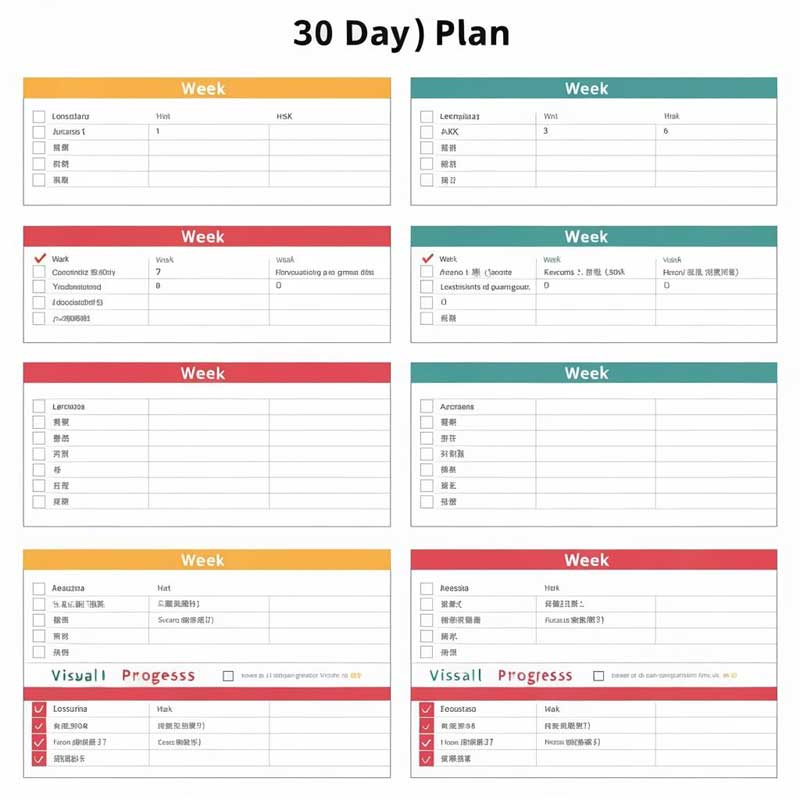
Week 1: Foundation (Days 1-7)
Focus: Master pinyin and tones
Daily tasks:
- Study 10 new vocabulary words
- Practice pinyin pronunciation for 15 minutes
- Review tone patterns (check my complete tone guide)
- Listen to HSK 1 audio for 10 minutes
Goal: Learn 70 words by end of week
Week 2: Vocabulary Building (Days 8-14)
Focus: Expand vocabulary to 150 words
Daily tasks:
- Learn 12 new words per day
- Review previous words with flashcards
- Practice writing characters (optional but helpful)
- Do 5 listening comprehension exercises
Goal: Complete all 150 HSK 1 words
Week 3: Grammar & Practice (Days 15-21)
Focus: Understand sentence structures
Daily tasks:
- Review all 150 words
- Study 2-3 grammar points per day
- Take 1 practice listening test
- Take 1 practice reading test
Goal: Finish all grammar topics and start practice tests
Week 4: Test Prep (Days 22-30)
Focus: Full practice tests and review
Daily tasks:
- Take 1 full HSK 1 practice test (40 min)
- Review mistakes carefully
- Focus on weak areas
- Final vocabulary review
Goal: Score 150+ on practice tests consistently
Complete HSK 1 Vocabulary List
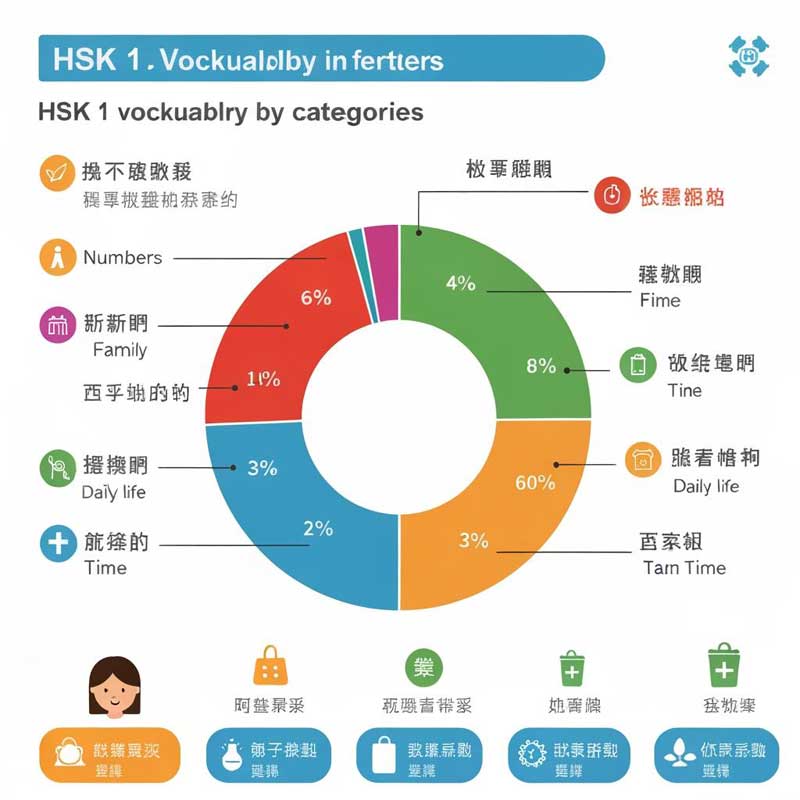
Here are the 150 words you need to know, organized by category:
Numbers & Time (15 words)
- 一 (yī) – one
- 二 (èr) – two
- 三 (sān) – three
- 四 (sì) – four
- 五 (wǔ) – five
- 六 (liù) – six
- 七 (qī) – seven
- 八 (bā) – eight
- 九 (jiǔ) – nine
- 十 (shí) – ten
- 年 (nián) – year
- 月 (yuè) – month
- 日 (rì) – day/date
- 今天 (jīntiān) – today
- 明天 (míngtiān) – tomorrow
People & Pronouns (12 words)
- 我 (wǒ) – I/me
- 你 (nǐ) – you
- 他 (tā) – he/him
- 她 (tā) – she/her
- 们 (men) – plural marker
- 谁 (shéi) – who
- 什么 (shénme) – what
- 名字 (míngzi) – name
- 先生 (xiānsheng) – Mr./sir
- 小姐 (xiǎojiě) – Miss
- 老师 (lǎoshī) – teacher
- 学生 (xuésheng) – student
Family (8 words)
- 爸爸 (bàba) – dad
- 妈妈 (māma) – mom
- 儿子 (érzi) – son
- 女儿 (nǚ’ér) – daughter
- 家 (jiā) – home/family
- 朋友 (péngyou) – friend
- 男 (nán) – male
- 女 (nǚ) – female
(The full 150-word list continues…)
Download tip: Create flashcards for all 150 words using Anki or Quizlet.
Essential HSK 1 Grammar Points
1. Basic Word Order: Subject + Verb + Object
Pattern: 我 + 吃 + 饭
Translation: I eat rice
Structure: Subject + Verb + Object
2. 是 (shì) – “To Be”
Pattern: 我是学生 (Wǒ shì xuésheng)
Translation: I am a student
3. Questions with 吗 (ma)
Pattern: 你是老师吗?(Nǐ shì lǎoshī ma?)
Translation: Are you a teacher?
Answer: 是,我是。/ 不是,我不是。
4. Negation with 不 (bù)
Pattern: 我不喝茶 (Wǒ bù hē chá)
Translation: I don’t drink tea
5. Measure Words (的 de)
Pattern: 我的书 (wǒ de shū)
Translation: My book
Need help with grammar? Check out my guide on Chinese sentence structure for more examples.
HSK 1 Test Format
Part 1: Listening (20 questions, 15 minutes)
Section 1 (5 questions): Listen and select matching picture
Section 2 (5 questions): Listen and decide if statement matches picture
Section 3 (5 questions): Listen to dialogue and select matching picture
Section 4 (5 questions): Listen to question and select correct answer
Part 2: Reading (20 questions, 17 minutes)
Section 1 (5 questions): Match pictures with words/phrases
Section 2 (5 questions): Match sentences with pictures
Section 3 (5 questions): Select word that completes sentence
Section 4 (5 questions): Answer questions about short passages
Study Tips for HSK 1 Success
1. Use Spaced Repetition
Don’t cram all 150 words in one day! Review words at these intervals:
- Day 1: Learn new words
- Day 2: Review
- Day 4: Review again
- Day 7: Final review
2. Focus on High-Frequency Words First
Some words appear more often in HSK 1:
- 我 (I)
- 是 (to be)
- 吗 (question particle)
- 不 (not)
- 的 (possessive marker)
3. Practice Listening Daily
Your ears need training! Listen to:
- HSK 1 listening practice tests
- Chinese children’s songs
- Slow Chinese podcasts
Want to improve your listening skills? Try these solo practice techniques that work for listening too!
4. Don’t Stress About Writing
HSK 1 is recognition only—you don’t need to write characters. Focus on:
- Reading pinyin
- Recognizing characters
- Understanding meanings
5. Take Practice Tests Weekly
Starting from Week 2, take one practice test per week to track progress.
Best HSK 1 Study Resources
Free Resources:
- HSK Academy: Free practice tests
- Chinese Test: Online HSK 1 questions
- YouTube: Search “HSK 1 listening practice”
Apps:
- HelloChinese: HSK 1 course included
- Pleco: HSK 1 flashcard deck
- Anki: Spaced repetition for vocabulary
Books:
- HSK Standard Course 1: Official textbook
- HSK 1 Workbook: Practice exercises
Test Day Tips
Before the Test:
- ✅ Get 8 hours of sleep
- ✅ Eat a good breakfast
- ✅ Arrive 30 minutes early
- ✅ Bring ID and test confirmation
During Listening Section:
- Read questions BEFORE audio plays
- Don’t panic if you miss one question
- Focus on keywords
- Trust your first instinct
During Reading Section:
- Skip hard questions, come back later
- Use process of elimination
- Watch the clock (17 minutes for 20 questions)
Common Mistakes to Avoid
❌ Mistake #1: Ignoring Tones
Many beginners focus only on vocabulary and forget tones. But HSK 1 listening tests tones heavily!
❌ Mistake #2: Not Practicing Listening Enough
The listening section is usually harder than reading. Practice more listening!
❌ Mistake #3: Studying Too Many Words
Stick to the official 150 words. Don’t waste time learning extra vocabulary.
❌ Mistake #4: Waiting Until the Last Week
Start your 30-day plan early. Cramming doesn’t work for language learning!
What Happens After HSK 1?
Once you pass HSK 1, you can:
- 📈 Move on to HSK 2 (300 words)
- 🗣️ Have very basic conversations
- 📝 Read simple Chinese texts
- 🎯 Set new learning goals
Final Checklist
Before test day, make sure you can:
- ✅ Recognize all 150 HSK 1 words
- ✅ Understand basic grammar patterns
- ✅ Score 150+ on practice tests
- ✅ Understand spoken Chinese at slow speed
- ✅ Answer questions confidently
You’ve got this! HSK 1 is totally achievable in 30 days with focused study. Start today, follow the plan, and you’ll pass with confidence! 💪
🎯 Need Personalized HSK 1 Preparation?
While self-study is powerful, working with an experienced teacher can dramatically improve your chances of passing—and help you learn faster.
I’m Candice, a professional Mandarin tutor specializing in HSK exam preparation. My students consistently achieve high scores because I focus on:
- ✅ Targeted vocabulary practice for HSK 1
- ✅ Pronunciation and tone correction
- ✅ Mock tests with detailed feedback
- ✅ Customized study plans based on your schedule
👉 Ready to pass HSK 1 with expert guidance? Explore my HSK preparation lessons designed specifically for exam success.
Want to know more about my teaching methods? Learn about my background and experience helping students ace their HSK exams.
Find the perfect package for your exam prep: Check out my affordable HSK tutoring packages.
Let’s get you HSK 1 certified! Contact me today to schedule your first lesson and start your journey to exam success.