Chinese New Year—also called Spring Festival (春节 Chūnjié)—is the most important and widely celebrated festival in Chinese culture. This isn’t just a one-day holiday; it’s a 15-day celebration filled with traditions, family reunions, symbolic foods, and ancient customs passed down for thousands of years! 🎊
Whether you’re planning to celebrate, visiting China during this time, or simply want to understand this fascinating cultural event, this complete guide covers everything you need to know!
What is Chinese New Year?
Chinese New Year marks the beginning of the lunar calendar and celebrates the arrival of spring. The date changes every year but always falls between January 21 and February 20.
2025 Chinese New Year Date:
January 29, 2025 – Year of the Snake 🐍
Quick Facts:
| Aspect | Details |
|---|---|
| Chinese Name | 春节 (Chūnjié) – Spring Festival |
| Also Called | 农历新年 (Nónglì Xīnnián) – Lunar New Year |
| Duration | 15 days (ending with Lantern Festival) |
| Official Holiday | 7 days in mainland China |
| History | Over 4,000 years old |
The Legend Behind Chinese New Year
The Story of Nian (年兽)
According to ancient legend, there was a ferocious beast called Nian (年) that would emerge on New Year’s Eve to devour crops, livestock, and even people—especially children!
How villagers fought back:
- 🧨 Firecrackers – The loud noise scared Nian away
- 🔴 Red decorations – Nian feared the color red
- 🏮 Bright lights – Kept throughout the night to ward off evil
This is why red, firecrackers, and staying awake on New Year’s Eve remain central traditions today!
Chinese Zodiac Animals
Each Chinese New Year is associated with one of 12 zodiac animals in a repeating cycle:
| Animal | Years | Personality Traits |
|---|---|---|
| 🐀 Rat | 2020, 2032 | Clever, resourceful, adaptable |
| 🐂 Ox | 2021, 2033 | Hardworking, reliable, honest |
| 🐅 Tiger | 2022, 2034 | Brave, confident, competitive |
| 🐇 Rabbit | 2023, 2035 | Gentle, quiet, elegant |
| 🐉 Dragon | 2024, 2036 | Powerful, lucky, energetic |
| 🐍 Snake | 2025, 2037 | Wise, mysterious, intuitive |
| 🐎 Horse | 2026, 2038 | Free-spirited, energetic, warm |
| 🐐 Goat | 2027, 2039 | Gentle, sympathetic, artistic |
| 🐒 Monkey | 2028, 2040 | Smart, curious, mischievous |
| 🐓 Rooster | 2029, 2041 | Observant, hardworking, confident |
| 🐕 Dog | 2030, 2042 | Loyal, honest, responsible |
| 🐖 Pig | 2031, 2043 | Generous, compassionate, optimistic |
Note: Your zodiac animal is based on your birth year in the lunar calendar, not the Western calendar! If you were born in January or early February, check the exact lunar new year date for your birth year.
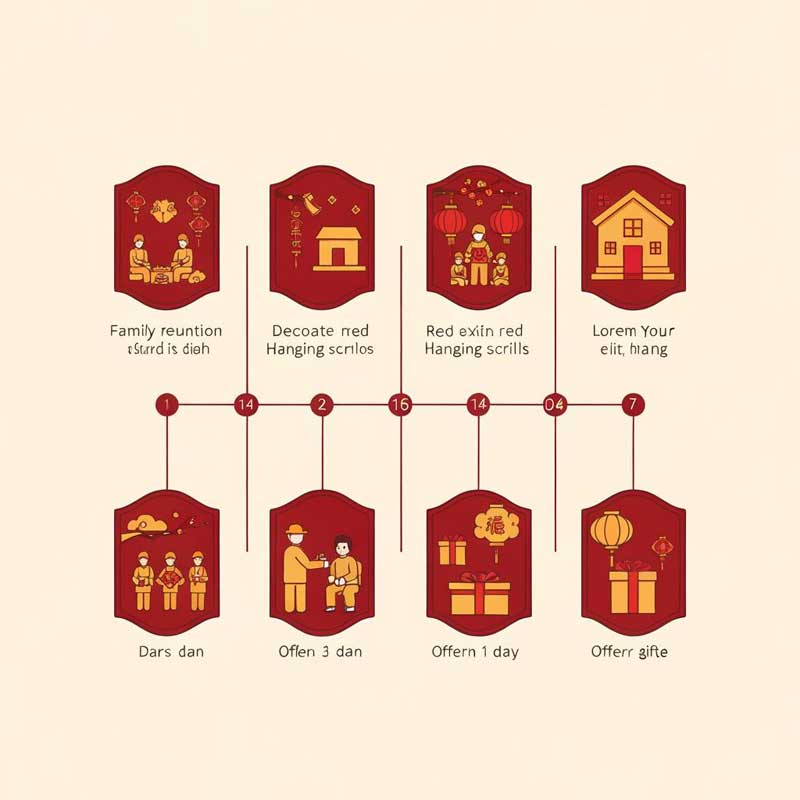
The 15-Day Celebration Timeline
Chinese New Year isn’t just one day—it’s a 15-day festival with different activities and meanings!
Before New Year’s Eve:
Little New Year (小年 Xiǎonián) – 8 days before:
- Deep cleaning the house (扫尘 sǎochén – sweep away dust/bad luck)
- Shopping for new clothes and decorations
- Preparing special foods
Day 1 (New Year’s Eve 除夕 Chúxī):
The most important day!
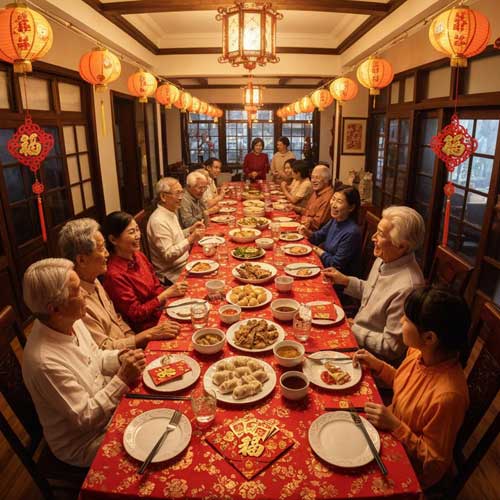
- 🍜 Reunion Dinner (年夜饭 Niányèfàn) – The most significant meal of the year
- 🎆 Staying up past midnight (守岁 Shǒusuì) – Brings longevity to parents
- 🧨 Firecrackers at midnight – Welcome the new year
- 📺 Watching CCTV Spring Festival Gala – National tradition
Day 1 (New Year’s Day 初一 Chūyī):
- 🎁 Red envelopes (红包 Hóngbāo) – Elders give to children
- 👘 Wearing new clothes – Symbolizes fresh start
- 🙏 Visiting parents/grandparents first – Shows respect
- 🎊 No sweeping! – Would sweep away good luck
Days 2-3:
- Visiting other relatives and friends
- Married daughters visit their parents’ homes
- Exchanging gifts and greetings
Day 5 (破五 Pòwǔ):
- Welcome the God of Wealth (财神 Cáishén)
- Many businesses reopen
- Eating dumplings for wealth
- Setting off firecrackers
Days 6-14:
- Continuing family visits
- Temple fairs and activities
- Returning to normal routine
Day 15 (Lantern Festival 元宵节 Yuánxiāo Jié):
- 🏮 Lantern displays and riddles
- 🍡 Eating tangyuan (汤圆) – Sweet rice balls symbolizing unity
- Official end of Spring Festival celebrations
Essential Chinese New Year Traditions
1. Reunion Dinner (年夜饭)
The most important meal of the year held on New Year’s Eve. Families travel from all over China to be together—this causes the world’s largest annual human migration (春运 Chūnyùn)!
Must-have dishes (each symbolic):
| Food | Chinese | Symbolism |
|---|---|---|
| Fish | 鱼 (yú) | Surplus/abundance (sounds like 余 yú) |
| Dumplings | 饺子 (jiǎozi) | Wealth (shaped like ancient money) |
| Spring rolls | 春卷 (chūnjuǎn) | Gold bars/wealth |
| Nian gao | 年糕 (niángāo) | Progress (sounds like 年高 – year higher) |
| Long noodles | 长寿面 (chángshòumiàn) | Longevity (don’t cut them!) |
| Whole chicken | 鸡 (jī) | Prosperity & togetherness |
Important: Leave some fish uneaten to ensure “surplus” carries into the new year!
2. Red Envelopes (红包 Hóngbāo)
Who gives: Elders, married couples, employers
Who receives: Children, unmarried adults, employees
Lucky amounts (must be even numbers):
- 100, 200, 600, 800 RMB – Good
- 666 RMB – Very lucky (6 = smooth/successful)
- 888 RMB – Extremely lucky (8 = prosperity)
Avoid:
- ❌ Any amount with 4 (sounds like death 死 sǐ)
- ❌ Odd numbers (except in southern China for some contexts)
- ❌ Opening red envelopes immediately in front of giver
Modern twist: Digital red envelopes via WeChat are now extremely popular!
3. Decorations (装饰 Zhuāngshì)
Red everything!
- 🏮 Red lanterns (红灯笼 hóng dēnglong) – Hung outside homes
- 🎋 Spring couplets (春联 chūnlián) – Poetic phrases on red paper
- 福 Fu character (福字 fú zì) – Hung upside down (倒 dào = arrive, so “福倒了” = fortune arrives)
- 🌸 Paper cuttings (剪纸 jiǎnzhǐ) – Intricate designs on windows
- 🎊 Chinese knots (中国结 Zhōngguó jié) – Symbolize unity
4. New Year Greetings (拜年 Bàinián)
Want to master all the greetings? Check out my complete guide to Chinese New Year greetings and wishes!
Most common:
| Chinese | Pinyin | Meaning |
|---|---|---|
| 新年快乐! | Xīnnián kuàilè! | Happy New Year! |
| 恭喜发财! | Gōngxǐ fācái! | Wishing you prosperity! |
| 万事如意! | Wànshì rúyì! | May all go well! |
| 身体健康! | Shēntǐ jiànkāng! | Good health! |
Chinese New Year Taboos & Superstitions
Things to AVOID during New Year (especially Day 1-3):
❌ Don’t Do:
- Sweep or take out trash – Sweeps away good fortune
- Wash hair on Day 1 – Washes away luck
- Break anything – Bad omen for the year
- Say unlucky words – Death (死 sǐ), sickness (病 bìng), etc.
- Use knives/scissors on Day 1 – Cuts off fortune
- Cry or argue – Sets negative tone for the year
- Wake people up – Means they’ll be rushed all year
- Wear black or white – Colors of mourning
- Give clocks as gifts – 送钟 (sòng zhōng) sounds like attending a funeral
- Use the number 4 – Sounds like death
✅ Do Instead:
- Finish all cleaning BEFORE New Year’s Eve
- Wear red and bright colors
- Keep all lights on New Year’s Eve
- Speak only positive, auspicious words
- Keep doors and windows open to let luck in
Regional Differences in Celebrations
Northern China:
- 🥟 Dumplings (饺子) are THE essential food
- Colder climate = more indoor family activities
- Traditional performances like yangge dance (秧歌)
Southern China:
- 🍚 Nian gao (年糕) more important than dumplings
- Warmer = more outdoor celebrations and temple visits
- Lion and dragon dances more common
- Flower markets (especially in Guangzhou)
Hong Kong & Taiwan:
- More integration of Western New Year with traditional Spring Festival
- Major public celebrations and fireworks displays
- Temple fairs and traditional markets
Modern Chinese New Year Celebrations
While traditions remain strong, modern life has added new elements:
Contemporary Trends:
- 📱 WeChat Red Envelopes – Virtual hongbao exchanges
- ✈️ Traveling abroad instead of hometown visits
- 🎬 Chinese New Year movies – Major film releases
- 🛍️ Online shopping festivals – New Year sales
- 📺 Short video greetings – Douyin/TikTok messages
- 🎮 Online gaming events – Special New Year promotions
Spring Festival Gala (春晚 Chūnwǎn):
The CCTV Spring Festival Gala is watched by over 700 million people annually! This 4-hour variety show features:
- Comedy skits (小品 xiǎopǐn)
- Song and dance performances
- Acrobatics and magic
- Celebrity appearances
Cultural significance: Families watch together while preparing midnight celebrations—it’s become as traditional as the reunion dinner itself!
Spring Travel Rush (春运 Chūnyùn)
Chinese New Year triggers the world’s largest annual human migration!
Statistics:
- Nearly 3 billion trips during the 40-day period
- Trains, planes, buses completely packed
- Tickets sell out months in advance
- Highways jammed with returning workers
Why? Cultural importance of returning home (回家 huí jiā) is so strong that people endure any inconvenience to reunite with family.
Travel tip: Avoid traveling in China 1 week before and after Chinese New Year unless absolutely necessary!
Experiencing Chinese New Year as a Foreigner
What to Expect:
If you’re in China during Spring Festival:
- 🏪 Most shops and restaurants CLOSED (Day 1-3)
- 🚌 Reduced public transportation
- 🏙️ Cities feel like ghost towns as people return to hometowns
- 🎊 Street celebrations and fireworks (if not banned locally)
- 🎭 Temple fairs and cultural performances
How to Participate Respectfully:
- Learn basic greetings – People appreciate the effort!
- Accept red envelopes graciously – Use both hands, say thank you
- Avoid taboos – Especially on Day 1
- Bring appropriate gifts when visiting – Fruit, sweets, alcohol (learn about gift-giving culture here)
- Show respect – This is their most important family time
Best Cities for Foreigners to Experience CNY:
- Beijing – Temple fairs, traditional performances
- Shanghai – Yu Garden Lantern Festival, modern celebrations
- Xi’an – Ancient city wall celebrations
- Hong Kong – International flower market, Victoria Harbor fireworks
Quick Do’s and Don’ts Summary
| ✅ DO | ❌ DON’T |
|---|---|
| Wear red and bright colors | Wear black or white |
| Say “恭喜发财” (Gōngxǐ fācái) | Say words related to death or illness |
| Give even-numbered money amounts | Give amounts with the number 4 |
| Clean before New Year’s Eve | Sweep or clean on New Year’s Day |
| Bring fruit/sweets when visiting | Bring clocks or scissors as gifts |
| Accept red envelopes with both hands | Open red envelopes immediately |
| Leave some fish uneaten | Finish all the fish |
| Stay up past midnight (守岁) | Go to sleep early on New Year’s Eve |
Learning Opportunity
Chinese New Year is a perfect time to:
- 📖 Learn festive vocabulary and greetings
- 🎭 Watch Chinese movies and TV shows about CNY
- 👨🍳 Try cooking traditional New Year foods
- 🎨 Practice writing 福 (fú) and spring couplets
- 🎵 Listen to traditional New Year songs
Cultural immersion accelerates language learning! Understanding the cultural context makes vocabulary stick and conversations more meaningful.
Conclusion
Chinese New Year is much more than a holiday—it’s a profound expression of family values, hope for renewal, and cultural identity that has endured for millennia. Whether you celebrate it yourself or simply want to understand Chinese culture better, knowing these traditions helps you connect more deeply with the Chinese-speaking world! 🎊
Remember: The essence of Chinese New Year is reunion (团圆 tuányuán), fresh starts, and good fortune. Everything else—the food, decorations, and customs—serves to celebrate and amplify these core values!
Want to explore more Chinese festivals? Check out my complete Chinese festivals calendar guide next!
🏮 Experience Chinese Culture Through Language
Understanding Chinese New Year traditions is one thing—being able to participate in conversations about them is another! That’s where cultural context meets language learning.
I’m Candice, and I help students:
- ✅ Learn festival vocabulary and greetings naturally
- ✅ Understand cultural nuances behind language choices
- ✅ Navigate social situations during Chinese celebrations
- ✅ Connect more authentically with Chinese culture
👉 Ready to celebrate Chinese culture through language? Explore my immersive Mandarin lessons that integrate cultural learning with practical conversation skills.
Curious about my cultural approach? Learn more about my background and how I blend language teaching with cultural insights.
Looking for the right learning package? Check out my lesson options and find what fits your goals.
Questions about Chinese culture or lessons? Contact me today and let’s discuss how cultural understanding can deepen your Chinese learning!
Have you experienced Chinese New Year? Share your story in the comments! 🎊