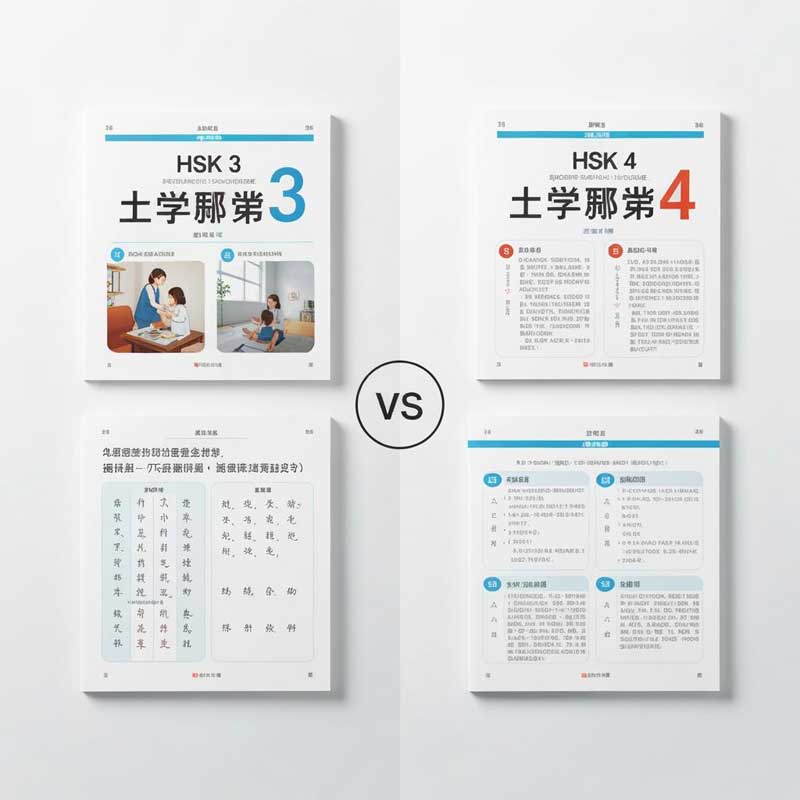
So you’ve passed HSK 2 and you’re ready for the next challenge. But here’s the big question: Should you take HSK 3 or jump straight to HSK 4?
The answer depends on your current level, study time, and goals. In this guide, I’ll compare HSK 3 and HSK 4 side-by-side so you can make the right choice.
Quick Comparison: HSK 3 vs HSK 4
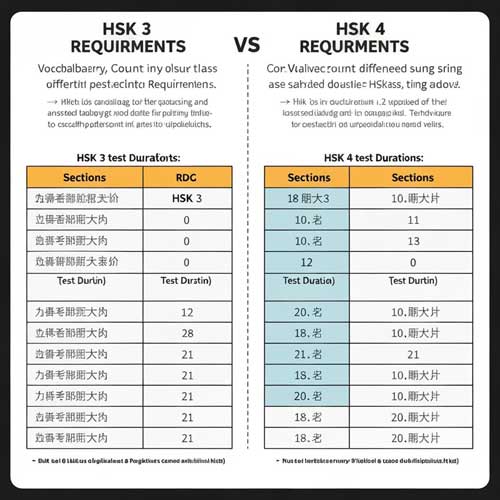
| Feature | HSK 3 | HSK 4 |
|---|---|---|
| Total Vocabulary | 600 words | 1,200 words |
| New Words to Learn | 300 (beyond HSK 2) | 600 (beyond HSK 3) |
| Test Duration | 90 minutes | 105 minutes |
| Listening Questions | 40 questions | 45 questions |
| Reading Questions | 30 questions | 40 questions |
| Writing Section | 10 questions | 15 questions |
| Study Time Needed | 2-3 months | 4-6 months |
| CEFR Level | A2 (Elementary) | B1 (Intermediate) |
| Difficulty Jump | Moderate from HSK 2 | Significant from HSK 3 |
What Is HSK 3?
HSK 3 is the upper-elementary level. Test-takers at this level can:
- ✅ Communicate in Chinese in daily life, study, and work situations
- ✅ Handle most basic communication when traveling in China
- ✅ Understand and express themselves on familiar topics
HSK 3 Test Format:
Part 1: Listening (40 questions, 35 minutes)
- Section 1: Dialogue + picture matching (10 questions)
- Section 2: Short dialogues + true/false (10 questions)
- Section 3: Dialogues + multiple choice questions (10 questions)
- Section 4: Longer passages + questions (10 questions)
Part 2: Reading (30 questions, 30 minutes)
- Section 1: Match sentences to pictures (10 questions)
- Section 2: Fill in blanks with provided words (10 questions)
- Section 3: Match question to answer (10 questions)
Part 3: Writing (10 questions, 15 minutes)
- Section 1: Arrange words to form sentences (5 questions)
- Section 2: Complete sentences using given words (5 questions)
If you’re new to HSK exams, start with my HSK 1 study guide to understand the exam format basics.
What Is HSK 4?
HSK 4 is the intermediate level. Test-takers at this level can:
- ✅ Discuss a wide range of topics in Chinese fluently
- ✅ Communicate with native speakers relatively fluently
- ✅ Express opinions and discuss abstract concepts
HSK 4 Test Format:
Part 1: Listening (45 questions, 30 minutes)
- Section 1: Short statements + true/false (10 questions)
- Section 2: Short dialogues + multiple choice (15 questions)
- Section 3: Longer dialogues + questions (20 questions)
Part 2: Reading (40 questions, 40 minutes)
- Section 1: Fill in blanks with provided words (10 questions)
- Section 2: Match sentences with passages (10 questions)
- Section 3: Read passages and answer questions (20 questions)
Part 3: Writing (15 questions, 25 minutes)
- Section 1: Complete sentences using given words (10 questions)
- Section 2: Write sentences based on pictures (5 questions)
Key Differences Between HSK 3 and HSK 4
1. Vocabulary Gap
HSK 3: 600 total words (300 new)
HSK 4: 1,200 total words (600 new)
The vocabulary jump from HSK 3 to HSK 4 is double the size. You need to learn twice as many new words!
2. Grammar Complexity
HSK 3 Grammar Includes:
- Basic 把 (bǎ) sentences
- Simple 被 (bèi) passive structures
- 比较 (comparative) sentences
- Basic result complements
HSK 4 Grammar Includes:
- Advanced 把 and 被 structures
- Complex result and direction complements
- 虽然…但是… (although…but…)
- 不但…而且… (not only…but also…)
- Conditional sentences (如果…就…)
HSK 4 grammar is significantly more complex. Need help with grammar? Check out my guide on Chinese sentence structure.
3. Writing Section Difficulty
HSK 3 Writing:
- Arrange given words into sentences
- Complete simple sentences
- No free writing required
HSK 4 Writing:
- More complex sentence completion
- Picture description requiring sentence composition
- Must use vocabulary creatively
4. Listening Speed
HSK 3: Slower, clearer pronunciation
HSK 4: Natural, faster speech with more complex dialogues
5. Reading Passages
HSK 3: Short, simple passages (50-80 characters)
HSK 4: Longer, more complex passages (100-150 characters)
Should You Take HSK 3 or Skip to HSK 4?
✅ Take HSK 3 If:
- You recently passed HSK 2
- You’ve studied Chinese for 6-12 months
- You want to build confidence before HSK 4
- You need certification for a specific purpose soon
- You’re learning at a relaxed pace
- You struggle with listening comprehension
✅ Skip to HSK 4 If:
- You passed HSK 2 with a high score (190+)
- You’ve studied Chinese intensively for 1+ year
- You can already read simple Chinese articles
- You’re comfortable with basic conversations
- You have 4-6 months to prepare
- You want to save time and money on exam fees
My Recommendation:
If you’re unsure, take HSK 3 first. Here’s why:
- 🎯 Builds solid foundation for HSK 4
- 📈 Boosts confidence
- 🧠 Prevents burnout from jumping too fast
- ✅ Gets you certified sooner
You can always take HSK 4 later—and you’ll be better prepared!
How Long to Study for Each Level?
HSK 3 Study Timeline:
If studying 1-2 hours daily: 2-3 months
If studying 30 minutes daily: 4-5 months
If taking classes: 1 semester (3-4 months)
HSK 4 Study Timeline:
If studying 2 hours daily: 4-6 months
If studying 1 hour daily: 6-9 months
If taking classes: 2 semesters (6-8 months)
Want to practice efficiently on your own? Read my guide on solo Chinese practice for effective techniques.
Study Plan: HSK 3 to HSK 4
If you decide to take both exams, here’s the optimal path:
Month 1-3: HSK 3 Preparation
- Learn 300 new vocabulary words
- Master HSK 3 grammar points
- Take practice tests weekly
- Goal: Pass HSK 3
Month 4: Break & Review
- Celebrate your HSK 3 success! 🎉
- Review HSK 3 material
- Start familiarizing with HSK 4 vocabulary
Month 5-9: HSK 4 Preparation
- Learn 600 new vocabulary words
- Study advanced grammar structures
- Practice reading longer texts
- Improve listening at natural speed
- Goal: Pass HSK 4
Common Challenges for Each Level
HSK 3 Challenges:
- ❌ Writing section (arranging words correctly)
- ❌ Understanding listening at moderate speed
- ❌ Remembering tone changes (3rd tone rule, 不/一)
HSK 4 Challenges:
- ❌ Large vocabulary (600 new words!)
- ❌ Complex grammar structures
- ❌ Fast listening speed
- ❌ Longer reading passages
- ❌ Picture description writing
Which Level Do Employers/Universities Prefer?
HSK 3 Is Accepted For:
- ✅ Teaching English in China (some schools)
- ✅ Basic Chinese language requirement proof
- ✅ Entry-level positions in Chinese companies
HSK 4 Is Accepted For:
- ✅ University admission in China (some programs)
- ✅ Chinese language major prerequisite
- ✅ Professional jobs requiring Chinese
- ✅ Scholarship applications
Important: HSK 4 is considered the “threshold” for practical Chinese use. Most opportunities require HSK 4 or higher.
Cost Comparison
HSK 3 Exam Fee: ~$40-60 USD
HSK 4 Exam Fee: ~$50-70 USD
If you skip HSK 3: Save $40-60
If you take both: Total cost ~$90-130
Consider: Is the extra certification worth the cost for your specific goals?
Sample Questions: HSK 3 vs HSK 4
HSK 3 Sample Reading Question:
问题: 我今天很累,因为昨天晚上我____了。
选项:
- A. 睡觉
- B. 没睡觉
- C. 要睡觉
Answer: B (didn’t sleep)
HSK 4 Sample Reading Question:
问题: 虽然这本书很难,____我还是想把它看完。
选项:
- A. 因为
- B. 但是
- C. 所以
Answer: B (but)
Notice the difference? HSK 4 uses more complex grammar patterns!

Best Study Resources
For HSK 3:
- HSK Standard Course 3: Official textbook
- Pleco: HSK 3 flashcard deck
- ChineseSkill app: HSK 3 exercises
For HSK 4:
- HSK Standard Course 4: Official textbook
- The Chairman’s Bao: Graded news articles
- Du Chinese: Reading practice at HSK 4 level
Final Recommendation
Take HSK 3 if: You want steady, confident progress
Skip to HSK 4 if: You’re ready for a challenge and have time to prepare
Remember: There’s no “wrong” choice! Both paths lead to fluency. Choose based on your:
- 🎯 Current proficiency level
- ⏰ Available study time
- 💼 Career/academic goals
- 💪 Confidence and motivation
Whichever level you choose, commit to consistent study and you’ll succeed! 🚀
🎯 Get Expert HSK Preparation Tutoring
Trying to decide between HSK 3 and HSK 4? Not sure if you’re ready? I can help!
I’m Candice, a professional Mandarin tutor with extensive experience preparing students for all HSK levels. I’ll:
- ✅ Assess your current level accurately
- ✅ Recommend the right HSK exam for you
- ✅ Create a personalized study plan
- ✅ Provide targeted practice and feedback
- ✅ Help you pass with confidence
👉 Explore my HSK preparation courses designed for exam success at every level.
See my approach to teaching: Learn more about my background and methods.
Ready to start preparing? Contact me today for a free consultation to determine your best path forward!
Check out my HSK tutoring packages and find the perfect option for your exam goals.